Showing posts with label Investment Tips. Show all posts

Buy Now or After Economic Crisis Hits


Buy Now or After Economic Crisis Hits


If I buy now, later crisis come, then I might lose my money. If I buy later, but crisis never come, then house prices could be even more expensive.
So, buy now or wait for crisis? Let’s try this mix and match method based on the tables and questions I have created on below. Just for fun, don’t take it too seriously.

Table 1: Capital Appreciation from 5% to 25% per annum

Year+5% p.a. 

(RM)
+10% p.a.

(RM)
+15% p.a.

(RM)
+20% p.a.

(RM)
+25% p.a.

(RM)
2010300,000300,000300,000300,000300,000
2011315,000330,000345,000360,000375,000
2012330,750363,000396,750432,000468,750
2013347,288399,300436,425518,000585,938
2014364,653439,230480,068622,000732,423
2015382,886483,153552,079746,400915,529

Step 1: Estimate the capital appreciation in percentage for the shortlisted property that you are interested to invest. 5%, 10%, 15%, 20%, 25% per annum, …? Refer Table 1. It gives you an idea of how much is your property values worth over the years.
Step 2: Answer yourself, when will the economic crisis hits Malaysia? Anytime, end of this year, 2013, 2014, 2015, …? This is to understand how long is the time frame you have for your property increase its value.
Step 3: Answer yourself, how much will property price drop after economic crisis hits? 20%, 35%, 50%, …? This is important to forecast what’s the impact of economic crisis on our property values.
Step 4: Answer yourself, how long do you think the market will take to recover from the economic crisis? 2 years, 3 years, 4 years, 5 years, …? You must understand how good is your holding power and be prepared for the worst scenario if you insist to invest in property now.

Table 2: Before Crisis (appreciate 5% p.a.) vs After Crisis (drop 20%, 35% or 50%)

Year+5%

(RM)
-20%

(RM)
-35%

(RM)
-50%

(RM)
2010300,000240,000195,000150,000
2011315,000252,000204,750157,500
2012330,750264,600214,988165,375
2013347,288277,381225,738173,644
2014364,653291,723237,025182,327
2015382,886306,309248,876191,443

Table 3: Before Crisis (appreciate 10% p.a.) vs After Crisis (drop 20%, 35% or 50%)

Year+10%

(RM)
-20%

(RM)
-35%

(RM)
-50%

(RM)
2010300,000240,000195,000150,000
2011330,000264,000214,500165,000
2012363,000290,400235,950181,500
2013399,300319,440259,545199,650
2014439,230351,384285,500219,615
2015483,153386,522314,049241,577

Example 1: Jane is considering to buy a house at RM363,000 this year and forecast it has potential to grow at 10% per annum, refer Table 3. Meantime, Jane believes that economic crisis will hits very soon in 2013 and forecast her property price might drop about 35% due to its not so good location. That means the property is worth only RM259,545 after depreciated 35% from RM399,300. Under this scenario, Jane should not go ahead for the deal, right?

Table 4: Before Crisis (appreciate 15% p.a.) vs After Crisis (drop 20%, 35% or 50%)

Year+15%

(RM)
-20%

(RM)
-35%

(RM)
-50%

(RM)
2010300,000240,000195,000150,000
2011345,000276,000224,250172,500
2012396,750317,400257,888198,375
2013436,425349,140283,676218,213
2014480,068384,054312,044240,034
2015552,079441,663358,851276,040

Example 2: Peter is considering to buy a house at RM396,750 this year and forecast it has potential to grow at 15% per annum, refer Table 4. Meantime, Peter believes that economic crisis will hits in 2015 and forecast his property price will drop not more than 20% due to its good and demanding location. That means the property is still worth RM441,663 after depreciated 20% from RM552,079, which is still higher than initial purchase of RM396,750. If this is the case, Peter should go ahead and buy now, right?

Table 5: Before Crisis (appreciate 20% p.a.) vs After Crisis (drop 20%, 35% or 50%)

Year+20%

(RM)
-20%

(RM)
-35%

(RM)
-50%

(RM)
2010300,000240,000195,000150,000
2011360,000288,000234,000180,000
2012432,000345,600280,800216,000
2013518,000414,400336,700259,000
2014622,000497,600404,300311,000
2015746,400597,120485,160373,200

Table 6: Before Crisis (appreciate 25% p.a.) vs After Crisis (drop 20%, 35% or 50%)

Year+25%

(RM)
-20%

(RM)
-35%

(RM)
-50%

(RM)
2010300,000240,000195,000150,000
2011375,000300,000243,750187,500
2012468,750375,000304,688234,375
2013585,938468,750380,860292,969
2014732,423585,938476,075366,212
2015915,529732,423595,094457,765

“Crisis is Danger and Opportunity”
My First House Down Payment


My First House Down Payment


How I save money for my first house down payment? Thanks to the savings in fixed deposit account, I managed to pay the 10% down payment home loan for my first property deal.
Basically, I do not expect any saving money tips from a financial expert. A complicated plan does not work well for me. So, I make my saving plan as simple as possible. In order to achieve our goal, we must have an action plan, that’s why I have written down a very simple action plan as follows:
  • 1st target: Save for 1st RM5,000 FD
  • 2nd target: Save for 2nd RM5,000 FD
  • 3rd target: Save for 3rd RM5,000 FD
  • 4th target: Save for 4th RM5,000 FD
It is a simple plan and I believe the objective is achievable for everyone, right! Besides, do some comparison between fixed deposit accounts in the market to find out the best FD rate. To check fixed deposit rate in Malaysia, click here. After that, start focusing to accumulate your savings.
The reason why I set it to RM5,000 per 1-month FD is:
  • During that time, RM 5k is the minimum amount for 1 month period which is shortest FD period
  • I save RM 5k for each FD so that I could withdraw the fixed deposit for emergency cases within the shortest time frame to avoid early withdrawal penalty
  • Fixed deposit account indirectly helps me not to overspending and to have better control in cash flow forecasting
No money to buy property now? Never mind, start your saving plan immediately from now.

Property Investment Strategy for Husband and Wife on Housing Loan


Property Investment Strategy for Husband and Wife on Housing Loan


For young married couple who want to maximize their credit ratings to get more housing loans and if you are just about started to do so, here is some key points to be taken into consideration:
1. Individual Savings / Fixed Deposit Account
Avoid joint account. Bank feels uncomfortable with money that you do not have full ownership on it. So, get yourself and your spouse a savings account, respectively. This should be practiced since day one. Bank wants to see you do have the habit of saving.
Same for fixed deposit account (FD), avoid joint account, if possible. Bank likes to see your FD certificates. In fact, that is the money banks get it from us to make more money for themselves by lending back to us as personal loan, business loan, student loan and etc at higher interest rates.
2. Individual Credit Card
Husband and wife should have their own credit card, respectively. It is good to start building a positive credit report via credit card since most of the people able to get one.
Bear in mind, banks always like to lend money to good paymaster. They want to know will you pay them back on time or not. Therefore, your payment patterns on credit card and others loan is an important guideline for them to judge you.
You have no way to runaway, because all the loans and credit cards’ payment history is shown in your CCRIS report (Central Credit Reference Information System) from Bank Negara Malaysia.
However, owning many credit cards doesn’t mean you are financially strong; on the contrary, the total credit limit of all the credit cards will affect your maximum housing loan limit. Take note.
3. Individual Investment Account
If possible, start investing as soon as you start earning. You may start from low capital investment like unit trust and go for regular investment plan, say investing RM200/month regularly and increase the amount over the years. Amount wise, say between 5-8% of your salary. Personally, public mutual fund is a good option.
Previously, I started to invest in unit trust regularly was mainly as kind of force savings for myself and I’m still continuing it until today. But now it has ‘accidentally’ became a plus point for me to secure a loan with better interest rates (as been told by a mortgage officer). In fact, I feel that investing money in shares market make more sense for me now.
Again, avoid joint account, if possible.
Another thing I want to highlight here is do not bank-in the rental collected from tenant to your spouse’s savings account or joint account because bank will not going to recognize it as your income.

Legal Fees Disbursement Fees Stamp Duties and Other Fees for Mortgage Agreement


Legal Fees Disbursement Fees Stamp Duties and Other Fees for Mortgage Agreement


What are the chargeable fees involved for signing a mortgage agreement? As we noticed, seem like bankers are no longer offering ZERO MOVING COST financing package for our home loan.
In another words, we have to either pay the legal fees for the housing loan agreement by ourselves or finance it into the loan. Perhaps the invoice issued by a lawyer firm on below may give you some ideas about the charges:
BANKING FACILITY OF RM 263,330.00
(A) FACILITY AGREEMENT
- Stamp duty on Original = RM 1,320.00
- Stamp duty on 3 copies thereof = RM 30.00
- Stamp duty on Letter of Offer = RM 20.00
- Preparation on Letter of Undertaking to Refund = RM 50.00
- Stamp duty on Letter of Undertaking to Refund = RM 10.00
- Preparation on Statutory Declaration = RM 100.00
- Stamp duty on 2 Statutory Declaration = RM 20.00
- Affirmation fee on Statutory Declaration = RM 16.00
- Search fee on Master Title = RM 60.00
- OA search on Borrower(s)/Purchaser(s) = RM 24.00
- OR and CCM search on Developer = RM 80.00
- ELDS fees = RM 150.00
- Miscellaneous disbursement = RM 50.00
- Printing charges = RM 50.00
- Transport, postage, telephone, charges and other incidentals not specifically mentioned herein = RM 250.00
- Legal Fees = RM 2,293.31
- 5% Government Services Tax of Legal Fees = RM 114.66
TOTAL ITEM A = RM 4,637.97
(B) ASSIGNMENT
- Stamp duty on Original and 3 copies thereof = RM 40.00
- Miscellaneous disbursement = RM 50.00
- Legal fees = RM 229.33
- 5% Government Service Tax of Legal Fees = RM 11.46
TOTAL ITEM B = RM 330.79
(C) POWER OF ATTORNEY
- Stamp duty on Original & 3 copies thereof = RM 40.00
- Registration fee on Power of Attorney at High Court = RM 100.00
- Miscellaneous disbursement = RM 50.00
- Legal Fees = RM 229.33
- 5% Government Services Tax of Legal Fees = RM 11.46
TOTAL ITEM C = RM 430.79
GRAND TOTAL (ITEM A, B AND C) = RM 5,399.55

Legal Fees for Buying Second Hand or Subsale House in Malaysia


Legal Fees for Buying Second Hand or Subsale House in Malaysia


EXAMPLE:
Subject Matter: SPA/House Erected on Individual Leasehold Title
Purchase Price: RM420,000
(A) LEGAL FEES:
  • To our professional charges in taking your instructions in respect of the said matter, to all attendances, consultations, correspondences and miscellaneous work incidental thereto = RM3,390
(According to the Solicitors’ remuneration Oder 1% of the first RM150,000 and 0.7% of the remaining amount of Purchase Price of RM420,000)
(B) OTHERS:
  • Lodgement of Private Caveat & Withdrawal of Private Caveat = RM350
  • CKHT 2A (RM200 for each purchaser) = RM200
  • 6% Service Tax = RM236.40
(C) DISBURSEMENTS:
  • Stamping Fees (RM10 @ four copies Sale and Purchase Agreements) = RM40
  • Entry of Private Caveat and Withdrawal of Private Caveat = RM420
  • Land Search = RM60
  • Bankruptcy Search for Vendor and Purchaser (RM15 per search) = RM30
  • Affirmation and Stamping of Statutory declaration (for SD caveat, SD Non Bankruptcy) = RM28
  • Traveling (inclusive of trips to and from Shah Alam land office for Land Search, entry of Private Caveat, to and from Shah Alam for Bankruptcy Search, to and from Stamp Office for stamping of documents, etc. and all hand deliveries to and collection from parties to expedite matters) = RM200
  • Stationery and Printing Charges = RM120
  • Telephone, Facsimile, Courier, Postage = RM150
Grand Total (A + B + C) = RM5,224.40
Please note that the following payments must be prepared by you:-
(D) BANK DRAFT IN FAVOUR OF “PEMUNGUT DUTI SETEM” (COLLECTOR OF STAMP DUTY) FOR THE FULL SUM OF RM7,400
Estimated Stamp Duty for the Memorandum of Transfer (subject to change depending upon valuation by the Stamp Office) estimated figure based on Purchase Price as a guideline
1% of the first RM100,000 = RM1,000
2% of the next RM400,000 = RM6,400
(to the nearest thousand)
(E) ESTIMATED REGISTRATION FEE FOR TRANSFER AT THE LAND OFFICE – BASED ON VALUATION BY STAMP OFFICE IN (A) ABOVE (FOR EVERY THREE MONTHS FROM DATE OF STAMPING) = RM400
(D) + (E) payable upon receipt of Notice of Adjudication by the Purchaser or prior to redemption of Property (if any) (penalty imposed by Stamp Office is settled late), whichever is earlier

MRTA Insurance for Home Financing


MRTA Insurance for Home Financing


Introduction of MRTA quotation. Assuming this is for an under construction property. The quotation doesn’t show the MRTA calculation. Most importantly, the total amount of money to be paid upon your death (sum assured) and surrender value is all listed down for each particular year. Hence, you know how much it covers for your home financing.
 

Initial Sum Assured (RM) : 250,000.00
Assumed Loan Interest Rate(i) % : less than or equal to 7%
Term of Coverage : 10 years
Deferment Period : 3 years

Insurance Coverage Details

Estimated Premium Amount
(RM)
Insurance Single Premium for life to be assured
RM 1,916.00
Insurance Single Premium for joint life to be assured
RM 2,675.00
Total Premium payable
RM 4,591.00

(A discount of 20% will be applied on the single premium for the younger of two lives to be assured)

Illustration of Estimated PRU Group Mortgage Benefits

Year
Sum Assured*
Surrender Value**
Surrender Value** 
(Joint-life)
Total Surrender Value
1
250,000.00
1,437.00
2,006.25
3,443.25
2
250,000.00
1,274.00
1,812.92
3,087.62
3
250,000.00
1,112.24
1,618.00
2,730.24
4
250,000.00
948.62
1,419.68
2,012.33
5
233,500.00
790.39
1,221.94
1,677.40
6
214,250.00
645.23
1,032.17
1,361.85
7
193,750.00
513.90
847.95
1,361.85
8
171,750.00
396.38
670.52
1,066.90
9
148,000.00
291.66
503.03
794.69
10
122,750.00
199.66
348.39
548.05
11
95,750.00
121.02
213.13
334.15
12
67,000.00
58.54
104.09
162.63
13
36,000.00
16.51
29.59
46.10

Remark:
* = Sum Assured at the beginning of year upon Death or TPD claim.
** = Total Estimated Surrender Value at the beginning of year. The estimated surrender values are calculated based on the actual premium paid.

If need any inquiry kindly contact Jay Soon @ 017-237 3878 

Estimate How Long To Double Your Money Using Rule of 72


Estimate How Long To Double Your Money Using Rule of 72

Rule of 72 is a simplified formula used to estimate how long it takes to double your money based on compounding interest calculation. Besides, it tells you also how fast your money will become half of its value due to inflation.
For layman who is not familiar with scientific calculator or financial calculator, Rule of 72 formula is one of the best ways to do fast calculation and basic analysis on compound interest investment.
COMPOUND INTEREST EXAMPLES
Example 1: Assumed you have invested RM50,000 into a investment product that give you interest rate of 6% per annum. That means twelve (12) years later, RM50,000 become RM100,000
Years Required to Double Your Money,
= 72 ÷ Interest Rate
= 72 ÷ 6
= 12 years
Example 2: Assumed you have invested RM10,000 into a investment product and expect to double the money within 8 years. Hence, ROI 9% per annum is required to achieve your target.
Interest Rate Required to Double Your Money within Targeted Time Frame,
= 72 ÷ Number of Years Targeted to Double Your Money
= 72 ÷ 8
= 9% per annum
HOW FAST INFLATION DEPRECIATES YOUR VALUE OF MONEY?
Example 3: Assumed inflation rate fixed at 4%, your RM20,000 become half of its value after 18 years.
Years Required to Half your Money,
= 72 ÷ Inflation Rate
= 72 ÷ 4
= 18 years
Generally, the Rule of 72 has increased my ‘financial sense’. That’s why I would like to share it with readers here and I believe you are able to master it within an hour. Treat it as mind training. Have fun with the simple math practice and invest your money wisely. All the best

What is the Property Tax Rate in Malaysia?


What is the Property Tax Rate in Malaysia?
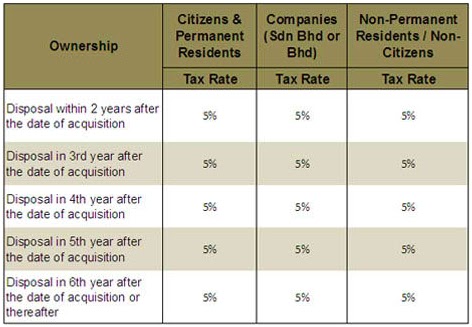
How is property tax determined for foreigner buying property in Malaysia? Surprisingly, both foreigner and local will be imposed the same property tax rate effective from 1 Jan 2010 as according to the announcement of latest Budget 2010 Malaysia by government.
Real Property Gains Tax (RPGT) at a fixed rate of 5% will be imposed on the gains from the disposal of real property for all categories of owners. What is Real Property Gains Tax?
REAL PROPERTY GAINS TAX ACT 1976 (SCHEDULE 5)

RPGT is a tax levied by the Inland Revenue Board (IRB) on chargeable gains derived from the disposal of real property. This tax is provided for in the Real Property Gains Tax Act 1976. The tax is levied on the gains made from the difference between the disposal price and acquisition price. Source: Valuation and Property Services Department, Ministry of Finance Malaysia
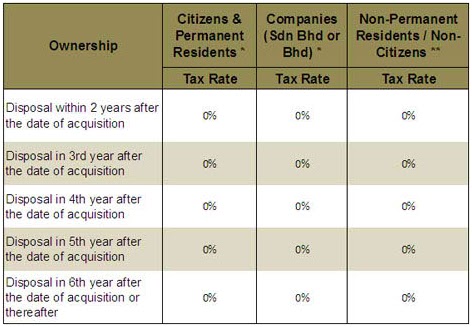
RPGT EXEMPTION – EFFECTIVE FROM 1 APRIL 2007
With effect from 1 April 2007, RPGT would not be imposed on gains made from the disposal of real property. The Real Property Gains Tax Exemption Order was gazette as P.U. (A) 146 on 1 April 2007, which excludes the application of all the rules of the Real Property Gains Tax Act. Source: Jabatan Penilaian Dan Perkhidmatan Harta Malaysia
RPGT 5% FLAT RATE – EFFECTIVE FROM 1 JAN 2010

In the Budget 2010 presentation, the Government proposed that real property gains tax at a fixed rate of 5% be imposed on the gains from the disposal of real property effective Jan 1, 2010. The Real Property Gains Tax (Exemption) Order 2009 will be gazette as soon as possible and is effective Jan 1, 2010. Source:Datuk Seri Ahmad Husni Hanazdlah, Second Finance Minister of Malaysia


Impact of 5% RPGT on Property Investment in Malaysia
New fixed rate of 5% Real Property Gain Tax (RPGT) has been proposed in Budget 2010 presentation recently. It will be implemented start from 1st January 2010. So, what are the impacts of 5% RPGT on property investment in Malaysia?
FOR HOME BUYER WHO,
Scenario 1: Buying New House from developer
§  If buying for own stay, you are not really affected as you may notice the developer and banker still offering attractive packages for new property
§  If buying for investment purposes, at least you are now aware about the 5% RPGT and it should be taken into consideration.
Scenario 2: Buying Second Hand house from sub-sales market
§  As a buyer, you are not affected directly because the RPGT will be imposed only on the gains from the disposal of the property for seller.
§  However, it has a minor impact on sub-sales market. Sellers start to hold back their selling plan due to the changes and uncertainty. Both seller and buyer are now in the ‘wait-and-see’ mode, hope for good news from Government of Malaysia.

FOR HOME SELLER WHO,
Scenario 3: Selling their house bought from developer or sub-sales market within short period (5 years, 3 years or earlier)
§  I think it is fair for Government to impose tax on those Investors who are making money from their property investment at a reasonable rate.
Scenario 4: Selling their house which has been bought/built for own stay many years ago (20 years, 30 years or even longer time)
§  RPGT was introduced mainly to prevent the property investor over speculates the market and cause bubble. Therefore, it is not fair to impose RPGT on home seller who bought their house thirty years ago. Some of them bought for own stay, not for investment.
§  Generally, most of the property experts believe the sub-sales market will be slow down for this coming few months but for short term only.

Well, don’t be surprise; anything can be changed over the night in Malaysia. Just imagine, 30% of RPGT was imposed on foreigner few years back, and then become 0% after announcement of RPGT Exempted started from 1st April 2007, but now 5% of RPGT is coming back. The inconsistent policies of RPGT have confused our foreigner investor and affected their confidence to invest in Malaysia